[UPDATE] 5.77 million lei in 60 days, from a single client.
An online store we run Meta and Google for. March 28 to May 26, 2026. 65,116 lei invested in ads, 5,776,607 lei in sales, 1,716 orders. Screenshots from both accounts are below, exactly as he would show you on screen.
Sales in 60 days
Orders
ROAS Meta / Google
Invested in ads
Why an update, and why no name.
The first case study shows how you pull an account out of losses. This one shows what comes after. The same two channels, Meta and Google, left to work on an already clean structure. The numbers below are not a one-day spike cut out for convenience, but the total of two consecutive months.
We do not name the client. Not because we avoid the numbers, but because a store generating nearly six million lei in two months does not want competitors looking into its account. The numbers stay exact, down to the last leu, and the name stays his. If you want to verify, we open the accounts live on a call, his logo right there on screen.
The window: March 28 to May 26, 2026. Two ad accounts, the exact same period. 65,116 lei invested in ads, 5,776,607 lei in sales, 1,716 orders. The numbers are in the screenshots below.
What holds this structure up.
Google, structured by margin, not volume.
Campaigns push the products that leave profit after all costs, not the ones with the highest search volume. Bidding on clean conversions, a feed with full specs, tracking that pulls returns out of the report. That is why average order value sits above 3,000 lei, rather than on products sold at a loss just to inflate the conversion count.
Meta, full-funnel on the products that sell.
Google captures the person already searching for the product, whereas Meta convinces the one who was searching for nothing. Budget concentrated on the hero products, pixel with eventId dedup, CAPI running. On Meta you build demand from scratch, so it is natural for ROAS to be lower than Google. Even so, it reaches 38x, a level most stores do not hit in a full year.
Reporting on profit, not ROAS for show.
The figure we steer the account by is net profit per order, not the favorable ROAS in the dashboard. The client sits in the same spreadsheet as us, sees the same figures, and decides together with us. This keeps the relationship clean and the numbers honest, since when you get paid from what we sell, you cannot afford to report anything but reality.
The numbers, by channel.
60 days, March 28 to May 26, 2026. No rounding in our favor. Exactly the figures from the accounts, visible in the screenshots below.
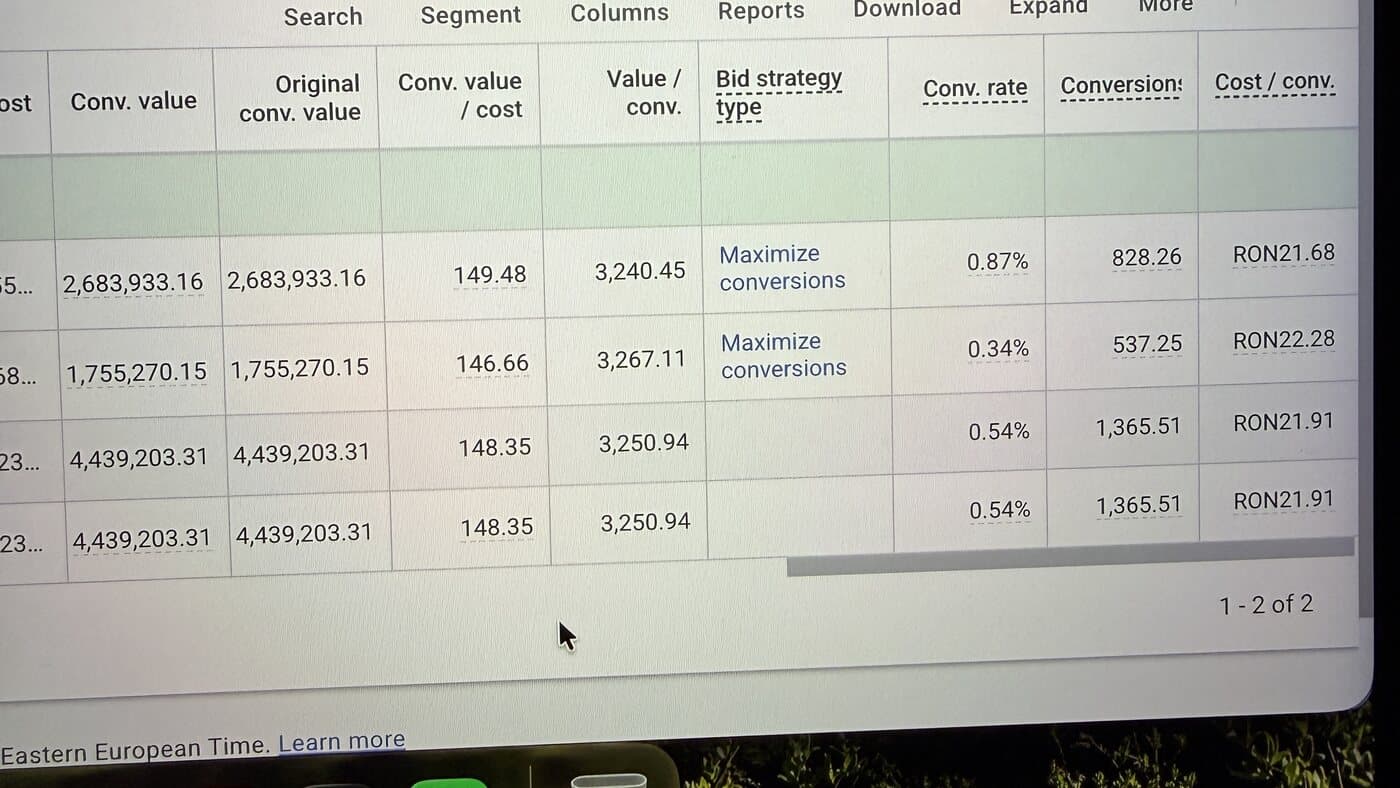
- Google Ads: 4,439,203 lei conversion value from 1,365 orders. 148x ROAS. Average cost per order 21.91 lei. Average order value 3,251 lei.
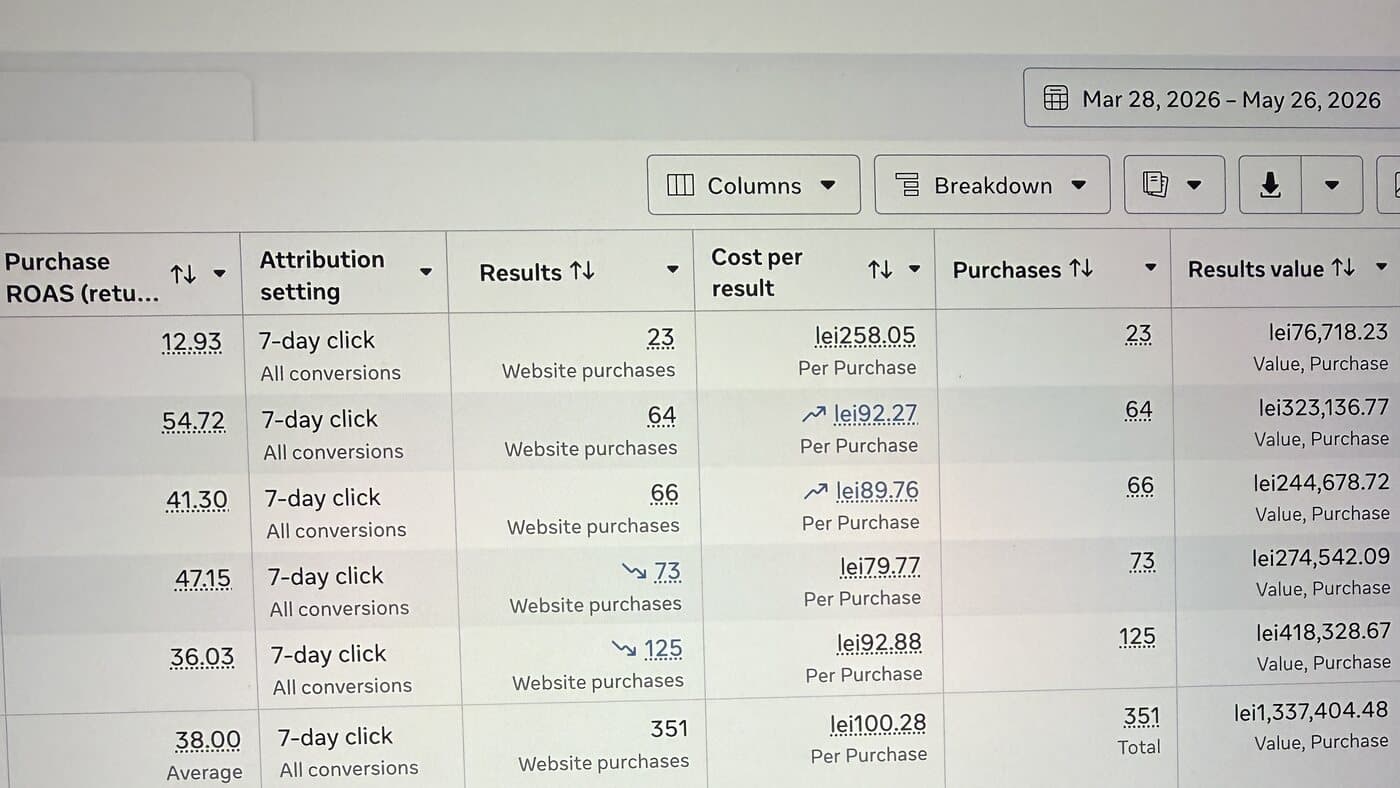
- Meta Ads: 1,337,404 lei in value from 351 purchases. 38x purchase ROAS. Average cost per purchase 100.28 lei.
- Combined total: 5,776,607 lei in sales from 1,716 orders, on 65,116 lei invested across the two channels.
- Google brings the volume and the value, since it captures existing demand on expensive products. Meta brings the new orders, from people who were searching for nothing. Two different roles, one single objective: profit, not impressions.
The screenshots, straight from the accounts.
These two are exactly what you would see if the client opened his accounts for you. Same window, March 28 to May 26, 2026. You can verify them anytime, on a call, with the client name on screen.
What keeps these numbers real.
- 01Average order value is high, above 3,000 lei on Google. Expensive products, healthy margin, a buyer who knows what he is paying for. That is why a ROAS that would look impossible on another store is real here, and it shows up in the till, not just the dashboard.
- 02Tracking counts real revenue, not inflated signals. Returns come out of the report, value is the real one per purchase, and Meta has eventId dedup. The number you see is the number that lands in the account, not the one the algorithm prefers to report.
- 03Two channels that do not cannibalize each other. Google on intent, Meta on new demand. Set them to compete over the same audience and you pay twice for the same order. Here each has its role, which is why the total comes out clean.
- 04You can verify it, and that is all that matters in a case study. On a call we open the accounts live. If the numbers were not real, we could not make the offer we make: you pay from what we sell, not upfront, on promises.