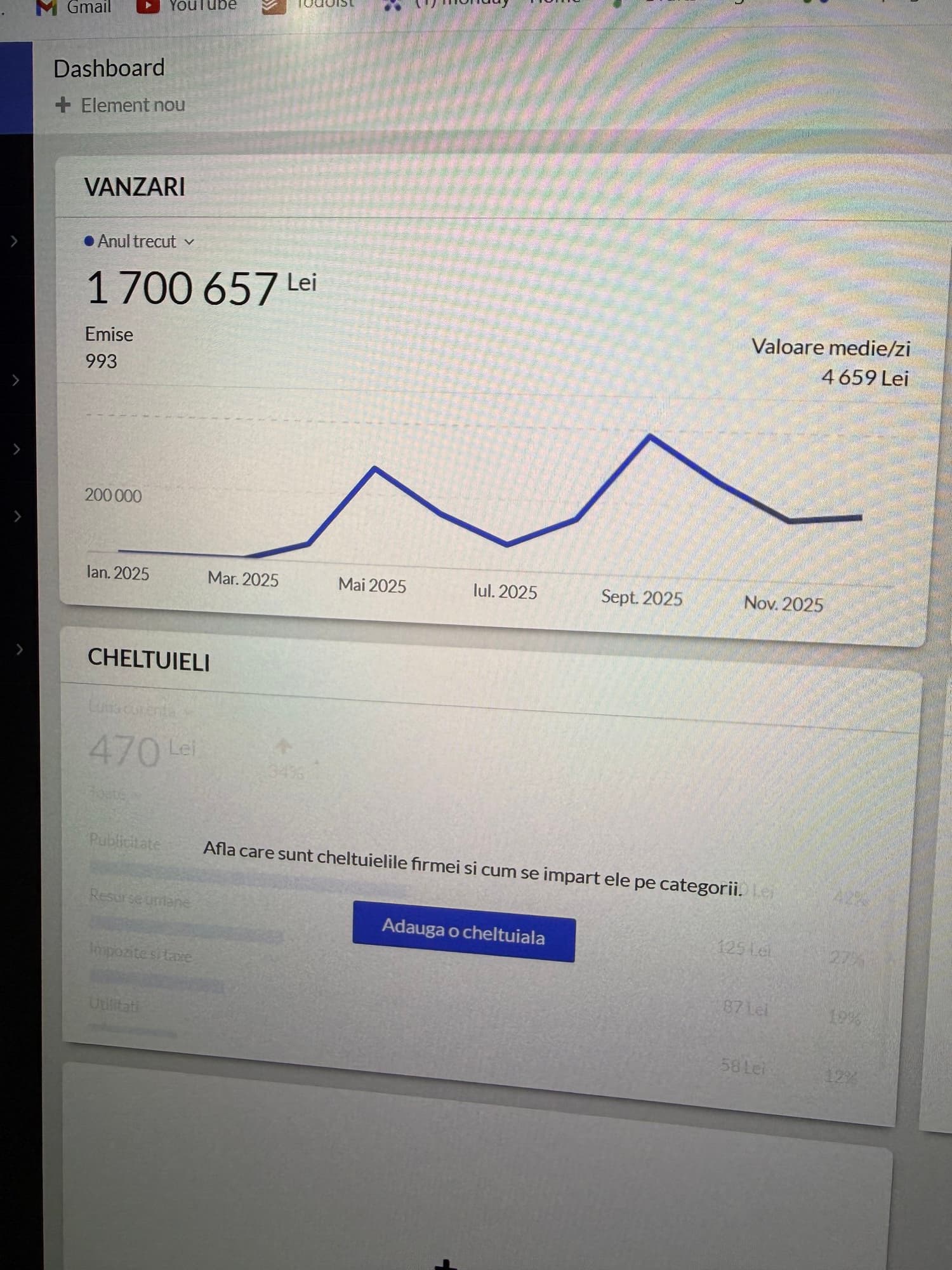
No digital presence, no experience, no marketing budget. And yet, 1,700,657 lei in one year.
Six people, a Facebook page, and an abandoned WordPress site. Four months with another agency, three thousand euros spent on reach, not a single trackable conversion. We started with a clean Pixel and an Excel file with net margins per package. We closed the year with 993 invoices.
2025 revenue
Invoices issued
Revenue / day 2026
Average POAS
Why does an agency with no budget call?
Because they had read what we wrote about POAS and understood it. They were not looking to be fooled, but to learn the reality. The opening message was short and honest: they had been following the POAS posts, they understood the logic, and they wanted to talk, yet they did not have a big budget. That is how most serious conversations begin. The ones who want to check whether it is worth it start here, whereas the ones chasing fairy tales open with "I want a million euros in 3 months."
The experience with the previous agency was recent. Four months, three thousand euros, reach and engagement campaigns. At the end, 12,000 new page likes, hundreds of enthusiastic comments, and one simple question nobody could answer: how many actual bookings came from those ads? None trackable. Not because the ads were weak, but because nobody had asked them for bookings, only for attention. The attention arrived, yet attention does not pay salaries.
When we got into the account, we found empty ground. No Pixel, no Conversion API, not even a custom event on a phone-number click. The booking page was the Facebook page itself: people sent DMs, and the team replied when it got around to it. Average response time was 6 hours, in an industry where the purchase decision is made in 45 minutes. Without a reply within 45 minutes, the customer had already booked elsewhere.
The most serious problem, however, was another. Of their 45 packages, nobody could say with certainty which were profitable after deducting guides, transport, accommodation, meals, and commissions. They had instinct and experience, but no numbers. In travel, with no numbers, you rely on luck. You win sometimes, without knowing why, and you cannot reproduce the result.
What do you find when you look IN the business, not AT reports?
Our audit did not stop at ads. We spoke with the ops team, two guides, and the admin department. From these conversations, plus an Excel with net margins per package, a picture emerged that nobody had seen.
- Of 45 packages, only 22 had net margin above 20%. Of the others, 15 were borderline and 8 were outright losses once you added returns, cancellations, and below-cost packages used for acquisition. Several of the packages they pushed most were precisely the ones causing losses. They were paying, therefore, to lose, without knowing it.
- Conversion infrastructure was entirely absent. Someone wanting to book a Rucar tour had to click the ad, land on Facebook, see a 2019 album with 23 photos, and only then send a DM. The estimated click-to-booking rate was under 1%, that is fewer than one client per 100 visits.
- Seasonality was treated as an obstacle, not a reality. Summer and winter budgets ran the same as spring and fall. In spring, CPA quadrupled, since nobody was buying a mountain retreat when it rained every weekend. The agency did not adjust, it only reported that things were not working.
- Old campaigns optimized for engagement, so Meta had learned to bring exactly the people who like and leave. 12,000 likes and zero bookings. This is not a limit of the platform, but of the strategy.
- The past customer list had over 800 names, never touched systematically. People who had bought a tour last year got nothing this year: no email, no SMS, no personalized offer. 800 people who had already proven they want to travel with the agency, completely ignored.
What we built. IN the funnel, AT every step, ABOVE instinct.
Two weeks devoted entirely to the numbers.
Before anything else, we did the net margin exercise on each of the 45 packages together with them. Guide cost (fee plus their accommodation), own or rented transport, traveler accommodation, meals, insurance, partnership commissions. Result: 22 packages worth ad budget and the rest to be sustained by organic and returning clients. Nothing was killed, only pulled from campaigns. We do not eliminate, we choose where the budget goes.
Clean tracking, from Pixel to offline.
Meta Pixel plus Conversion API on every funnel step: package view, details click, checkout initiation, confirmed booking, payment received. Offline event tracking for in-office cash payments. The first month of data was decisive, because we could see exactly where people dropped off. 40% abandoned at the details step, since the page was too long and loaded in 9 seconds on mobile.
Dedicated landings, not a full website.
We did not build a new site, as it was too expensive and too slow. We built three simple landings for three big categories (mountain, retreat, rural), each with clear social proof (the 5-star Google reviews nobody had been using), real trip photos, transparent pricing, FAQ, and three-step booking. WhatsApp Business for fast reply. Under 45 minutes, lead-to-booking conversion was 38%, whereas over 4 hours it dropped to 12%.
Full funnel on Meta, controlled budget.
TOFU with short Reels of 15 to 30 seconds, filmed by a guide on his phone, real destinations, authentic commentary. Not professional video, but real video. MOFU with carousels combining package, price, and testimonial. BOFU with time-limited offers and retargeting on abandoners. Starting budget 800 euros a month, raised gradually as POAS held. We did not launch at 3,000 euros on day one, but started modestly, validated, and only then scaled.
Seasonal scaling, not blind.
Winter packages (wellness retreats, snow-themed tours) had higher POAS than summer. Counterintuitive, yet clear in the data: premium clients seek calm during the holidays, not discounts. Winter budget went up 1.5 times, and summer 2 times on classic mountain packages. In spring and fall, drastically reduced budget, fine targeting on existing clients, and email to the 800-name past buyer list. Every euro spent when people do not want to travel is a euro wasted.
Google Ads and email, after month eight.
Once Meta had generated over 1.1 million lei in the first seven months, we added Google Ads on local and brand keywords, plus an email flow with seasonal reminders and personalized recommendations. Retention on ads-acquired clients reached 85% over 12 months, since the ads attracted the right people, not bargain tourists. Customers who come for price leave for a lower price, whereas those who come for the experience stay.
Their SmartBill. Tax numbers, not convenient reporting.
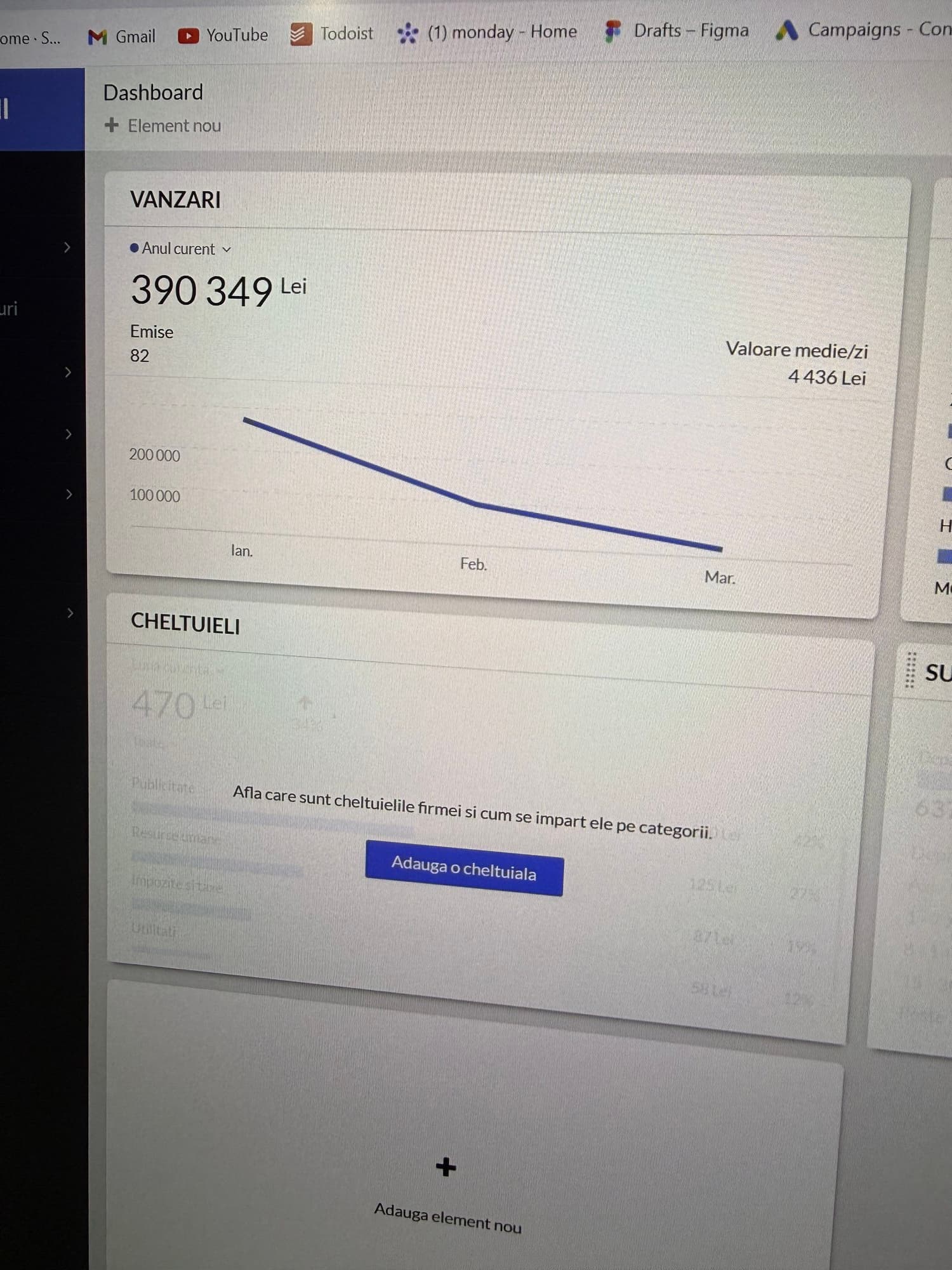
These are not Meta reports adjusted for effect. These are their invoices, in their system, which anyone can verify on a call with their team. Full fiscal year 2025, plus Q1 2026.
The numbers that mattered most.
Data from SmartBill and Meta Ads Manager. Full fiscal year 2025 (12 months), compared to the prior year.
| Metric | Before | After | Note |
|---|---|---|---|
| Annual revenue from ads | ~0 RON | 1,700,657 Lei | full 2025, Meta from month 1, Google and email added from month 8 |
| Invoices from ads | 0 | 993 | in 12 months |
| Average daily revenue (2026) | ~0 RON | 4,337 Lei | Q1 2026 |
| Cost per booking | N/A | 18.40 EUR | |
| Average POAS | Negative | 3.2x | |
| Active packages in ads | N/A | 22 / 45 | rest on organic |
| Client retention from ads | N/A | 85% | return within 12 months |
| Wasted budget prior | 3,000 EUR | 0 | no trackable conversions |
| Lead conversion under 45 min | N/A | 38% | |
| Lead conversion over 4 hours | N/A | 12% |
Where we got it wrong too.
Far from perfect. There are three moments we still come back to, and we know we would approach them differently today.
- We underestimated autumn. In September 2025 we kept the budget at summer level, since it was working. Within two weeks, CPA doubled, because the cold audience stayed the same while purchase intent dropped naturally. We spotted the problem only after two consecutive days with zero bookings. We cut the cold campaigns and moved spend to retargeting and email. Had we prepared the seasonal plan two weeks earlier, we would not have lost those weekends. Seasonal planning is not optional, it is mandatory.
- In month three we got excited and built separate landings for seven sub-categories. Only three drew meaningful traffic, while the other four consumed time and sat empty. Next time: three well-thought-out landings, A/B test, then add another if it justifies itself. You do not build it all on day one. Build a little, see what sticks, and add on what works.
- In month four, in the middle of scaling, we did not discuss capacity enough with the ops team. The result was two weeks with WhatsApp response times between 12 and 18 hours, and the lost bookings went to competitors. The capacity conversation comes before scaling, not after. You cannot bring 100 leads a day if the team can process 20, because the math does not forgive.
What we learned and what we carry forward.
- 01On services with strong seasonality, budget planning goes one quarter ahead, not on the fly. Travel made it obvious. With any cyclical client (education, fitness, beauty), we now build a 12-month budget calendar before the first campaign. We do not guess at random, we plan.
- 02Premium audiences do not react to discounts, but to calm and to their own time. Winter packages generated higher POAS at a higher cost per booking. Consequently, we drop the percentage-off on premium segments and run exclusive offers, short lists, personal messaging. Discount attracts price buyers, whereas exclusivity attracts value buyers.
- 03WhatsApp Business with a sub-hour reply outperforms any perfect landing page. Whenever response time dropped below 45 minutes, lead-to-booking conversion reached 38%, and over 4 hours it dropped to 12%. All new projects include a response-time SLA in the contract, as an obligation, not a suggestion.
- 04Email to your existing client base is the cheapest sales reserve. Their list of 800 past buyers, contacted monthly with seasonal reminders, generated around 110,000 lei in a year, at zero ad cost. On any business with strong retention, email is the first lever we build, before scaling cold. It is cheaper to keep a customer than to bring a new one.